Sinéad Hughes Portfolio
Case Study
24 Hour Universal Design Challenge
In order to highlight the importance of implementing Universal Design in Ireland Sinéad Hughes (Reynolds) got involved in the 24 hour Universal Design Challenge which took place on the 4th – 5th of November 2009. This event was organised by the NDA (National Development Authority), TrinityHaus and CEUD (Centre of Excellence in Universal Design). The purpose of this research was to work in an environment focusing on designing a product not only for people with disabilities but something that is also accessible for the general public. This was achieved by teaming professionals from all areas of design (Architecture, Engineering, Graphic Design and Web Design) into five teams. Each team was made up of professionals along with members of the public who currently live with a disability. The aim of the challenge was to provide all members of each group with an understanding of the importance of Universal Design from all points of view and to promote public awareness.
This case study looks at the Sinéad’s involvement and experiences of the challenge and how Universal Design was achieved by her team’s contribution to the challenge.
There were five teams set up with a variety of design disciplines. Each team was given their own conference room were they had to come up with a design idea over the next 24 hours. Team members were introduced to each other and given an itinerary and a map. They were each assigned a different route through the city. All teams were assigned a design sponsor who was a member of the public with a disability, to help identify obstacles and problems that was found along the route.
Each team had to come up with a design idea over 24 hours which was to be designed and presented to a team of judges and members the public. All teams worked throughout the night to come up with a solution based on their experiences to fulfil the principles of universal design.
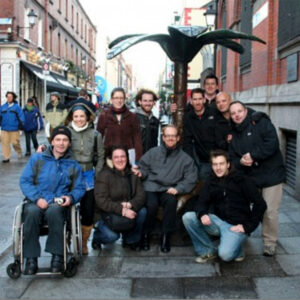
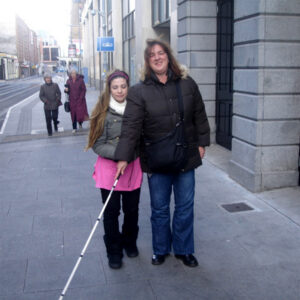
Sinéad was put in the group ‘Team A’ which consisted of Engineers, Web Designers, Graphic Designers, Lecturers, an Architect, Genny (a blind girl from Italy) and students. Team A’s research area was a section of Abbey Street between Liffey Street and Capel Street. The new team walked through the area, photographed, observed and got inspiration on how inaccessible to everyone the street was. The team also took several notes and photographs to document their findings.
When the team returned to their conference room, they were challenged to come up with an idea from their experiences. Everyone on the team had strong personalities and differences of opinions were inevitable but everyone had fun and everyone’s points of view were heard. It was agreed that it is not possible to re-design Dublin City itself so an aid for people to get around using the easiest route for them was the teams’ solution.
‘Team A’ discovered that a user friendly device/App for anyone with disabilities but not exclusively for people with disabilities is a required object in today’s built environment for accessibility and getting around the City. The team worked through the night and agreed on a device, a GPS system with an on-line profile account. This App updates users’ routes which they can review their progress online. The on-line account group members with similar abilities to together so the top routes for them will be shown; such as, cyclists, wheelchair users, elderly, tourists, buggy users/young children, blindness/poor visibility, deaf/hard of hearing but also just for fun for users to log distances and routes they have walked.
The next morning all teams had to submit a 7 minute presentation and description of the product which was held in the Hub, Guinness’ for presentations and awards. There were two prizes, the Judges Choice Award and the Peoples Choice Award. ‘Team A’ won the peoples choice award which all the other team members and audience (150 people in total) voted for.
The result of the study proposed a device/app to help those with disabilities to cope better with the existing built environment, rather than looking at redesigning it completely. The drive of most of the legislators at local, national and international level is to improve the built environment for universal access. Concentrating on upgrading the people, to make life more accessible to them, rather than accepting they have disabilities and changing the environment to suit them.